


From 0 to 22L in 45 Days
Most new brands take 3-4 months to figure out what works on paid ads. This jewelry brand didn't have that luxury. The founder had put her savings into the first inventory run and needed the brand to start generating revenue fast. Not eventually. Fast. When she came to us, the Shopify store had zero orders, zero reviews, and zero-pixel data. We had 45 days to change that.
The Brand and What They Were Working With
The brand sold imitation jewelry rings, earrings, necklaces, and statement pieces priced between ₹799 and ₹1,899. The product photography was clean, shot on white backgrounds. The Instagram page had around 3,200 followers, mostly from organic posts the founder had been putting up for 6 months before launch.
What they didn't have: an audience that bought. Social followers are not buyers. Instagram likes are not purchasing intent. We had to build that from scratch.
The other thing they didn't have was a track record on Meta. No pixel history, no purchase events, no lookalike audiences to pull from. We were starting from absolutely zero on the ad account side too.
Starting a brand with zero data means your first two weeks of ad spend is buying information, not buying customers. You have to be okay with that.
What We Diagnosed Before Touching the Ads
Before we launched a single campaign, we spent 4 days doing three things.
First, we audited the store. The product pages were weak. No size/fit context, no styling inspiration, no social proof. For jewelry, people need to see the product being worn in real life. Static white background images don't close the gap between 'that looks nice 'and 'I want to wear that'. The store was aesthetically okay but conversion-wise, it was leaving money on the table.
Second, we looked at what competitors were running. We spent time in the Meta Ads Library studying what jewelry brands at similar price points were doing with their creatives. Three patterns showed up consistently in ads that had been running for 90+ days: unboxing reactions, outfit pairing videos, and occasion-specific content like 'what I wore to a wedding'.
Third, we mapped out which audience angles made sense: women buying for themselves, women buying as gifts, and women buying for occasions. Three distinct motivations that needed different creative angles and different copy.
The UGC Strategy: Why We Did This Before Running Any Ads
For a zero-history brand in jewelry, running ads with product photography against cold audiences almost never works. People don't trust unknown jewelry brands they've never heard of. The risk of disappointment is too real the jewelry looks different in person, the quality is unknown, there are no reviews. Brand photography adds to that anxiety.
UGC removes it. When a real woman opens a package on camera, reacts to the jewelry, and shows it being worn it builds the trust that a studio photo never can.
We sourced 8 UGC creators for this brand. The brief was specific: no scripted lines, no forced enthusiasm. We wanted natural reactions, real unboxings, and styling content that showed the jewelry being worn with actual outfits.
- Creator 1-3: Unboxing reactions, focus on packaging and first impressions
- Creator 4-5: Outfit pairing videos, showing 3different looks with the same piece
- Creator 6-7: Occasion-specific wedding guest, office party, date night
- Creator 8: Gifting angle, filmed as if showing a friend what to gift someone
Total: 14 videos produced before we ran a single rupee in ads. This was a 10-day process. We launched ads on day 11.
Campaign Structure: How We Built the Account
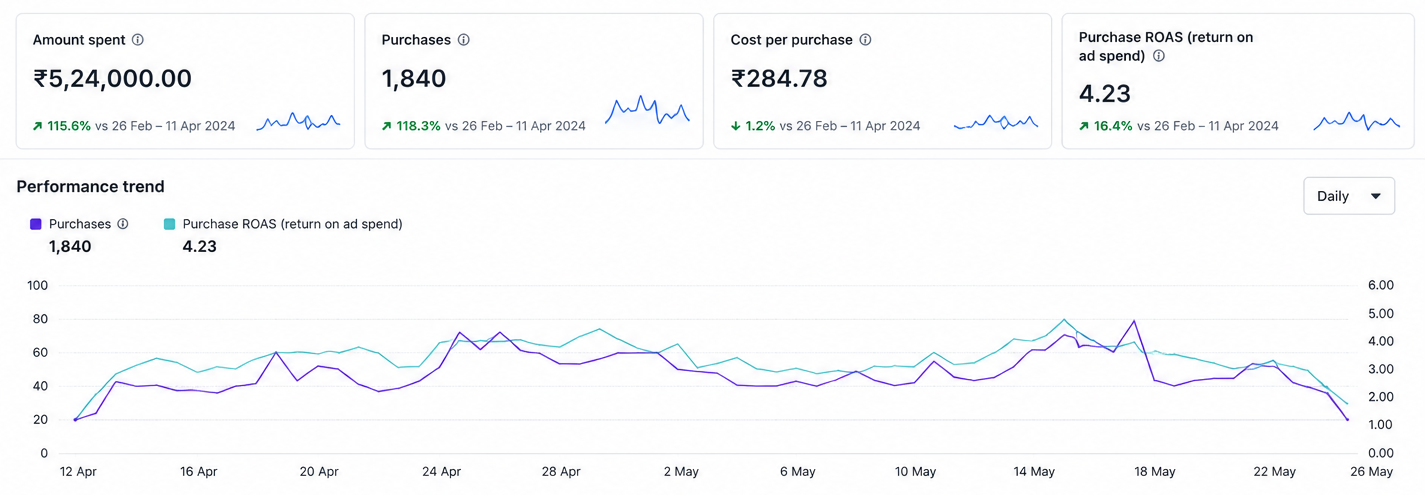
With no prior data, the account structure had to be simple and deliberate. Over-complicating a new account is one of the most common mistakes agencies make. Too many campaigns, too many audiences, too little data per ad set and the algorithm never learns anything useful.
We launched with 3 campaigns.
- Campaign 1 (Cold TOF): 4 ad sets targeting broad interest audiences fashion, ethnic wear, jewelry, and wedding shopping each with 3 creative variants.
- Campaign 2 (Retargeting MOF): Launched on day 10 once the pixel had enough visits, targeting anyone who viewed a product page but didn't add to cart
- Campaign 3 (Cart abandonment BOF): Launched on day 14, targeting add-to-cart abandoners with urgency-based copy
Daily budget on day 1 was ₹8,000. We didn't go higher until we had enough purchase data to justify it. By day 12, the pixel had 180 purchases. That's when we started scaling.
What the Data Showed Us in Week One
Week 1 ROAS across all campaigns was 1.9. Not impressive. Expected. With a new pixel on cold audiences, 2x is a good starting point. What mattered more was which creatives were driving CPPs below ₹350 our target for the brand's margin structure.
The unboxing video from Creator 2had a 4.8% CTR and a CPP of ₹218. The outfit pairing video from Creator 5 had a3.9% CTR and CPP of ₹264. Everything else was above ₹400. We killed the under performers at day 5, concentrated budget on the two winners, and requested4 more video variations from those same creators.
Creative testing is not about running everything and seeing what sticks. It's about finding two winners fast, understanding why they won, and making more of the same.
Scaling: Week 2 to Day 45
From day 12, we increased daily budget by 25% every 3 days on campaigns holding above 3.5x ROAS. This is a disciplined scaling rule that prevents the algorithm from resetting into learning mode.
We also introduced catalog ads in week 3. Once the pixel had enough data on which products were being viewed most, catalog ads let us show the right product to the right person automatically. This dramatically improved retargeting efficiency.
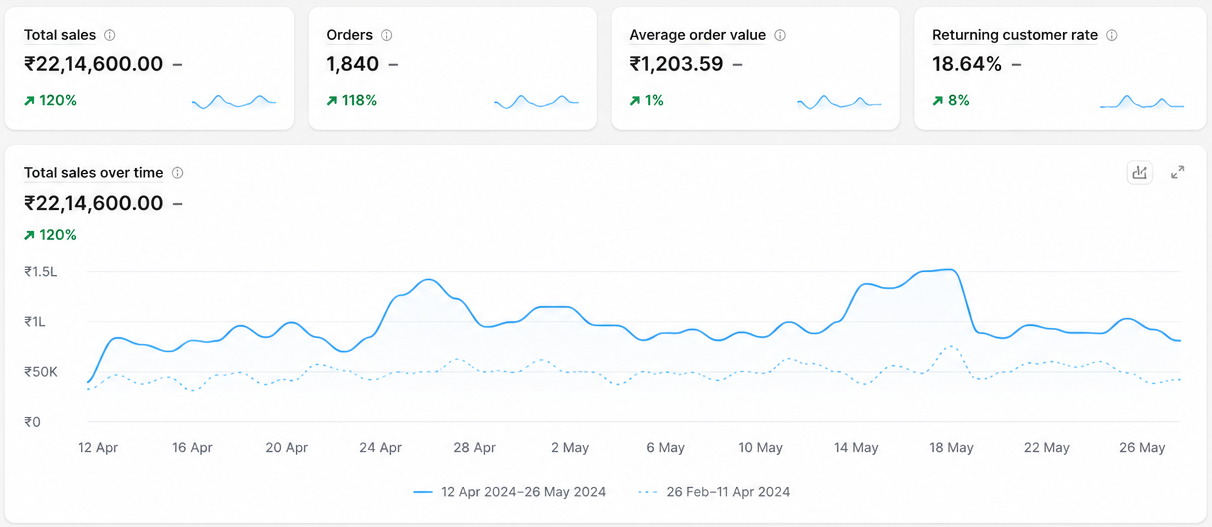
By day 30 we were at ₹11.4L in revenue. By day 45 we closed at ₹22.14L.
The Final Numbers
45 days. ₹22.14L revenue. 1,840 orders. ₹1,203 average order value. ₹5.24L in ad spend. 4.2x ROAS. CPP of ₹285.
For a brand that had zero sales history, zero-pixel data, and zero reviews 45 days earlier that is a functioning, profitable DTC business.
The brand is still running with us. Monthly revenue in month 3 crossed ₹38L.